Tuesday, 23 May 2017

SO, WHO ARE THE ‘STAKEHOLDERS’?


‘When I use a word’, Humpty Dumpty said, in a rather scornful tone, ‘it means just what I choose it to mean—neither more nor less’.

‘The question is’, said Alice, ‘whether you can make words mean so many different things’.

‘The question is’, said Humpty Dumpty, ‘who is to be master—that’s all’.

Lewis Carroll, Through the Looking Glass, Ch.6


What is a’ stakeholder’?

As every gambler knows, a ‘stake’ is the money or other consideration put up as a wager, or bet, that a hypothetical event is going to take place, like a fancied nag winning the Melbourne Cup, a favoured candidate being elected to political office, or a councillor’s friends getting permission to build an oversized shed.   

It also means a post stuck in the ground.   That’s no coincidence.  Centuries ago, gamblers would place their wagers on such a post, and in time, a wager came to be known as a ‘stake’.

Later, in the 18th century, the word extended its meaning to include having an interest of almost any kind in any situation involving some degree of uncertainty or risk. 

From the earliest days, it was customary for an independent person, one who wasn’t betting, to hold money or goods staked by gamblers, in trust (so to speak) for the eventual winner of the bet.   That person, predictably, became known as a ‘stakeholder’.

A stakeholder had no interest in the result of the wager other than a duty to hand over the amount staked to the winning party (or parties, where multiple stakes were involved).

That is what ‘stakeholder’ meant until the end of the 20th century.  My 1982 Macquarie Dictionary simply defines the word as ‘the holder of the stakes of a wager’. 

I presume ‘stakeholder’ still has that meaning, but in recent years the word has been hijacked by the corporate world.   In the hands of government bureaucrats and their equivalents in industry and commerce, it has acquired a further meaning, namely, a person who has a direct interest of any kind in the outcome of a given situation. 

That meaning contradicts the original meaning, which applied as I’ve said to somebody who had no such interest but was essentially neutral regarding any such outcome.

Confusion

We live in a time of much linguistic confusion.  Fine distinctions in the meanings of words are being recklessly discarded in favour of bureaucratic distortions and the vagaries of everyday speech. 

No doubt influenced by the prevailing climate of political correctness—no variety of English is superior to any other, every ‘text’ ranks as literature and ‘all must have prizes’—even professional lexicographers now act on the principle that paths of grammatical and semantic usage should always be laid where most people walk.  

What does it matter, they say, if speakers and writers use ‘infer’ to mean ‘imply’, ‘affect’ to mean ‘effect’, ‘less’ to mean ‘fewer’ and ‘stakeholder’ to mean something close to the opposite of its traditional meaning?

It matters because in every such instance, a semantic distinction is lost, with a corresponding loss of linguistic precision.  Take the case of ‘less’ and ‘fewer’, which signify a distinction between ‘uncountable’ (abstract or generic) and ‘countable’ (concrete) nouns—hence less bread, fewer loaves; less money, fewer banknotes; less disputation, fewer arguments; less propagation, fewer plants; less government, fewer taxes, and so on.   These days ‘less’ is busily driving ‘fewer’ out of currency, and our language is the poorer for the loss.

I suppose that for those who use language as often to obscure as to clarify, or simply to make an impressive noise, linguistic precision is hardly going to be a paramount consideration.

Who ‘holds a stake’ in the YRCC?

Those pedantic reflections—as I suspect most readers will think them—have been prompted by an exchange of emails between Suzie Haslehurst, the Shire’s Executive Manager of Corporate and Community Services, and me concerning a ‘workshop’ (don’t get me started on that one) to be held for ‘stakeholders’ in the YRCC.

Suzie uses the word ‘stakeholders’ in its bureaucratic sense, to mean persons having a direct interest in the future of the project.   Having made my protest, in that respect I will follow her lead.

 Referring to an earlier email, I wrote to ask her what she meant in this instance by ‘stakeholders’.  I wanted to know whether the term included ratepayers in general, or was restricted to representatives of sporting clubs ‘and perhaps habitual users of the tavern’.

I added that in my view, ‘every one of York’s ratepayers, without exception, has a considerable “stake” in the future of the YRCC’.

In her reply, Suzie agreed that every York ratepayer has an interest in the future of the YRCC.  That, she said, ‘is why the engagement process included the option for public submissions to give everyone in the community an opportunity to provide input’.

She continued: 

In light of the fact that the operational model and ‘user pays’ principle were key themes in the submissions, [Council] determined that the stakeholders for the purposes of the workshop are the users resident at the YRCC.  These include the sporting clubs and event holders that utilise the YRCC on a regular basis and whose members may be actively involved in the implementation of the future management model(s) being explored. We will also be discussing with the users the fees and charges for the use of the facilities at the YRCC as part of this workshop.

To which, after thanking Suzie for her email, I responded as follows:

Without wishing to carp, I have to question the logic of your second paragraph.  The fact that the 'user pays' principle was a key theme in community submissions is no reason to exclude the wider community from participation in the workshops.  To the contrary, community members who support that principle need to be present to ensure that the people you have identified as stakeholders - who would seem very unlikely to favour full application of the principle - are not able unchecked to restrict its application to the issues under discussion.

I think there is widespread community support for the proposition that 'user pays' should apply not only to fees and charges but also to such aspects of maintenance and asset renewal as caring for and when necessary replacing the surfaces of courts and greens.  Is it likely that members of relevant sporting clubs would agree to that?  I doubt it.

What Council has decided regarding workshop participation is tantamount to stacking the process in favour of people who have a vested interest in perpetuating the status quo so far as the funding of their activities is concerned.  That is a disappointing manoeuvre, redolent of the Shire's dismal past.  I'm certain it won't go unnoticed and unremarked.

I forgot to add that the arrangement Council decided on gave ‘stakeholders’, i.e. ‘users resident at the YRCC’, two bites of the cherry while the rest of us got only one.  They had the same opportunity to provide submissions as us common or garden ratepayers, but none of us was invited to take part in the workshop held last Thursday.  That was unfair.

What happened at the workshop?

Obviously, I don’t know much about that, because I wasn’t there.  But from the little I’ve managed to glean from rumour and report, it appears that my worst fears were realised.  For the most part, the ‘stakeholders’ present—mainly representatives of sporting clubs—showed little or no enthusiasm for the ‘user pays’ principle or the idea that they should take over responsibility for managing the centre, the option they had gathered to discuss.

I understand that all councillors attended except Cr Randell.  Others present, apart from Suzie Haslehurst, included the irrepressible former shire president Pat Hooper and former councillor Brian Lawrance, each of whom played no small part in the establishment of the YRCC.

An unsigned list of questions (see below) circulated at the workshop may provide a useful guide to the mood of participants. 

It reveals anxiety over the prospect of stakeholders having to manage and fund their own leisure activities as well as a contemptuous disregard for the interests of the majority of ratepayers who have had to shoulder the burden of paying for the centre at no discernible benefit to themselves.

It also reflects the naïve view that the centre is an asset that has the capacity in and of itself to attract business and population to York.  As I’ve pointed out several times in the past, that’s putting the cart before the horse.  Families move to take advantage of economic opportunities like jobs, not in search of sporting facilities. 

The YRCC has been in operation for several years. During those years, York’s population has at best stagnated, at worst declined, despite the existence of what the anonymous questioner describes as ‘state of the art resources’ incorporated in the centre. 

It’s worth reminding the clubs that York possessed a reasonably vibrant sporting culture before they fell into the trap of giving up their premises and independence in response to the blandishments of former CEO Ray Hooper, former shire president Pat Hooper, former councillor Brian Lawrance and other members of the council of the day.

What happened was sad, not to say disgraceful, but the clubs shouldn’t expect the generality of ratepayers to subsidise the result of their folly.   If they’d followed the wise example of the Croquet Club, which voted to retain its independence by staying put, they wouldn’t be holed up in their present predicament.

Discussion

I have no information about the discussion that took place in the workshop, but I’ll hazard a guess that it included some reference to the privileged position of the Hockey Club and to how the Shire swindled the Tennis Club out of a million dollars when it persuaded the club to migrate from its former premises.

And chances are that at least one of the clubs would have mentioned the trouble they would have in fundraising and in finding volunteers to work in the tavern bar.

My impression is that our councillors find themselves in a quandary. 

On the one hand, they seem to favour the proposition that the clubs should form an association to take over the management of the YRCC, including the restaurant and bar. 

On the other hand, they feel some sympathy with the clubs, as we probably all do (though in our case at any rate, perhaps not with the absurd sense of entitlement by which the clubs seem to be animated if the questions circulated at the workshop are anything to go by).

Presumably, the Shire will tell us in due course, or as Sir Humphrey Appleby would say, in the fullness of time and at the appropriate juncture, exactly what did happen at the workshop, what was actually said and who said it.

More to the point, it might reveal what action will flow from decisions made by Council in the light of what participants had to say about the option(s) presented to them.

One thing I’m certain of—no decision will emerge for at least a year, perhaps longer.   So ratepayers, expect to continue for some time subsidising the meals of those who dine at the tavern, and competitive neutrality be damned.
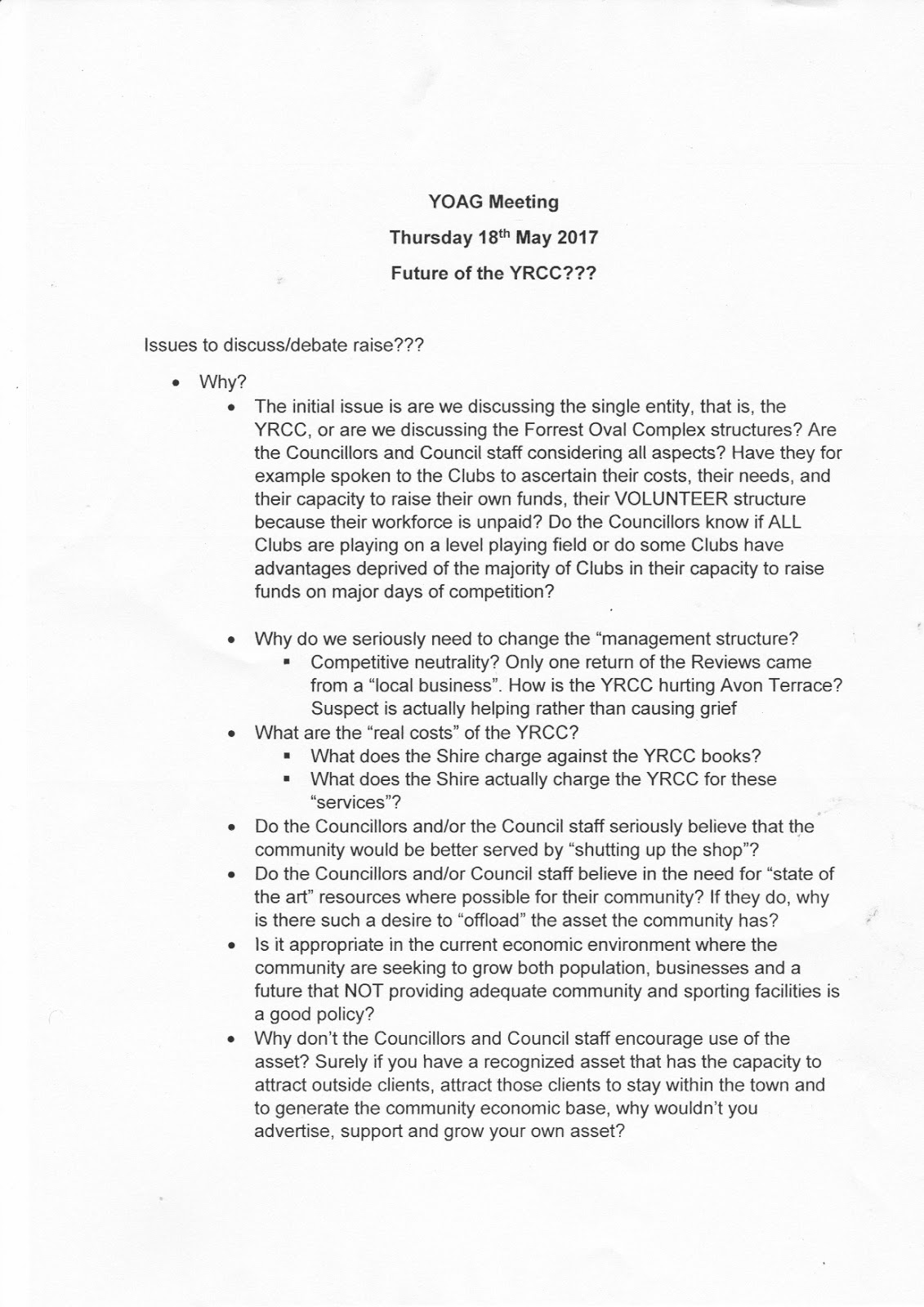
(Click to enlarge)

(Click to enlarge)


Friday, 5 May 2017

BUREAUCRATS IN LOVE


(or, Pop go the weasel words)


(I wrote these verses in 2006 as a skit on the hieratic version of English favoured by government departments of every type and level in Australia and no doubt everywhere else in the Anglophone world. Nothing much has changed since then.  They were read at a literary festival to an appreciative audience but have since languished in a desk drawer where some readers may believe they should have stayed. JP.)


We met on the escalator,
that’s where our liaison began:
I’d just finished drafting outcomes
for the Joint Strategic Plan.

He was clad in the corporate dress code,
he sported a power tie;
I knew he was aspirational
by the hungry look in his eye,

but he smiled like a people person,
and as the stairs were rising
he whispered ‘Do you have any needs
I could help with actualizing?’

It sounded like sexual harassment
but I thought it might mean advancement,
a holistic opportunity
for assertive career enhancement,

so I let him take the leadership role
to optimize our relations:
we made a date for the following night,
then returned to our workstations.

Yes, that was how it began:
our nexus inflamed by passion
we frequently interacted at work
in an inappropriate fashion.

At last came the paradigm shift
(promoted, of course, by my mother):
we could integrate our resources,
I could be his significant other,

so I said to him, "Look, you’ve impacted
in quality ways on my life;
let’s maximize our potential
recycled as husband and wife".

Then my game plan deconstructed.
He responded, "That’s a decision
I’m not empowered to facilitate,
not in terms of my vision –

it’s not what I’d call best practice.
See it from where I sit;
it’s hard to put marital structures in place
if you’re not ramped up to commit.

Our relationship started on steroids
but now it’s on respirators.
In short, my dear, you’ve ceased to meet
key performance indicators.

My true love is customer service.
They warned me at business school
that sex in a workplace context
could downsize my management tool.

You’ve never been my core business,
just a flexible bit on the side.
Regrettably, this is the juncture
where our destinies divide".

I said to him, "I’m in agreeance",
for just at that moment in time
I could see the bastard for what he was –
an iconic parcel of slime.

I took my revenge in the office,
I did it in one fowl swoop,
I refused to massage his figures
and left him out of the loop.

I thought he was focused on excellence
but now he’s gone to the bad:
I’d just call that a negative outcome
if it wasn’t so fucking sad.  

James Plumridge

Tuesday, 25 April 2017

JURMANNS INVADE BEVERLEY


‘Resistance useless’, terrified residents cry

Some York readers may remember Jacky Jurmann and her husband Tim.  Jacky was employed for three years from 2011 as the Shire of York’s planning officer or ‘manager of planning’, while Tim served the Shire as a building inspector.

In 2014, both Jacky and her husband jumped ship.  Jacky set herself up as director of a consultancy, Glenwarra Development Services.  In that capacity she continued for some time to provide advice to the Shire regarding SITA’s landfill application. 

Why did she resign?  Well, as I reported on this blog in August 2015 (see http://shireofyork6302realvoice.blogspot.com.au/2015/08/the-history-channel_15.html ), the popular explanation at the time was that she had done so in anger because the Shire had refused or ignored her request for it to delete all references to her from the ill-fated (i.e. rigorously suppressed) Fitz Gerald Report of 2014.

Enter Mike Fitz Gerald

Unluckily for Jacky, the Fitz Gerald Report (FGR) is freely available at various places on the Internet, for example at http://yorkwatransparency.weebly.com/uploads/4/2/7/1/42713461/york_final_report.pdf . 

As book reviewers used to say, it’s a rattling good read.  I commend it to the upstanding burghers of Beverley, where Jacky (and Tim) are currently employed.

The Shire of York, under then Shire President Matthew Reid, appointed Mr Mike Fitz Gerald to investigate serious questions concerning the conduct of then CEO Ray Hooper.  

Mr. Fitz Gerald’s investigation led him to raise additional questions about the conduct of Shire employees alleged to have acted maliciously under CEO Hooper’s direction (or on his caprice). 

One of those employees was Jacky Jurmann.

According to Mr Fitz Gerald, Jacky was an aggressively uncooperative witness, refusing to answer his questions on the supercilious and irrelevant grounds that she was a professional planner and he was not.   

I’d say that refusal was a mistake, because she passed up the opportunity to defend herself against allegations that as York’s manager of planning she had behaved, presumably at Ray Hooper’s behest, in ways unbefitting a professional planner (or any kind of professional, come to that).

In particular, she might have been able to tell us if (or explain why) she dealt as alleged in the report with planning issues relating to a couple of local enterprises, now sadly defunct, namely Saint’s Diner and The Dog’s Bollocks.

 I don’t propose to detail in this article the questions posed in the FGR about Jacky Jurmann.  Instead, I’ll just leave you with the link (given above) and a list of the numbered paragraphs that refer specifically to her, namely 2, 7.19, 7.21, 7.22, 7.49, 7.59, 7.62, 7.63, and 7.64.

My advice is to read the whole report.  It won’t take long, and you might come away with some valuable insights into what can go wrong in a small rural community under the thumb of a dictatorial CEO who is aided and abetted by a couple of gormless shire presidents (neither of them, I hasten to add, the public-spirited Matthew Reid) and a bunch of lickspittle councillors.

You might also find yourself wondering why the Department of Local Government insisted that the York Shire Council suppress the FGR; why it persecuted Matthew Reid and dismissed the Council for authorising the report; why the allegations the report contains have never been properly followed up by the CCC or any other government agency; why no politician of any stripe found the story interesting enough to give it a parliamentary airing, and why our current councillors seem to have conspired with successive shire administrations to keep the report officially under wraps.

Read it and weep.

Jacky reinvents herself, but I guess she’s still the same gal

In January of this year, the Shire of Beverley appointed Jacky Jurmann to the position of Shire Planner.  At the same time, it found work for husband Tim as building inspector.

For now, Jacky is also filling in as manager of health services.

Hold on a moment.  I must stop calling her ‘Jacky’.   She isn’t ‘Jacky’ any more.  On the Shire of Beverley website, her name appears as ‘Jacqui’. 

I must say the new name does seem more aristocratic, or at any rate, less, shall we say, bogan.

But to me the change seems a bit like putting your hands over your eyes in the hope that nobody can see you.

Despite her change of name, Jacqui still appears as Jacky Jurmann on the FIGJAM website Linked In.  There, she lists her qualifications as a ‘postgraduate’ bachelor’s degree (surely a bachelor’s is an ‘undergraduate’ degree?) from UNE in urban and regional planning; a master’s in ‘social ecology’ from Western Sydney, and an associate degree in health and building surveying from Sydney TAFE.

For those who don’t know what ‘social ecology’ might be, it’s an approach based on the radical ideas of the late US anarchist and utopian philosopher Murray Bookchin to the analysis (or in the modern jargon, ‘deconstruction’) of social and environmental issues. 

In some ways, social ecology is a fine example of the green-left nonsense peddled in today’s universities as an alternative (or antidote) to despised activities like traditional scholarship, rational argument, free and open debate and the use of commonsense.

York readers will be interested to know that real estate agent Michael Watts is listed on Jacky/Jacqui’s Linked In page as a person who ‘endorses’ her local government knowledge and skills. 

Mr Watts cracks a mention in the FGR as chairperson of the former Shire-sponsored York Tourist Bureau and Visitors’ Centre.   That enterprise fell in a heap after his daughter, controversially employed by the bureau as a bookkeeper despite a prior criminal conviction for stealing, diverted a very large sum of her employer’s money to her own use and purposes.   You can read all about it in numbered paragraph 5 of the FGR.

Jacky Jurmann as York's planning officer, 2014
Muscle car madness in Beverley

It didn’t take long for Jacky/Jacqui to make her mark as Beverley’s Shire Planner.  She’d only been in the job for a couple of weeks when she found herself facing a real social ecology challenge—an application to set up a muscle car tuning shop at 46 Dawson Street.

Allegedly, the applicant, Adrian ‘Pip’ Smith, is a friend and neighbour of Shire President Dee Ridgway, which of course if true would have had no relevance whatsoever to the success of his application. 

I only mention that because when the application came before council, a naughty resident asked during PQT if councillors were there to represent residents of Beverley ‘or their mate’.  Council responded that it was ‘quite offended’ by the question, and anyway four of the eight councillors present didn’t know Mr Smith, so there.

Another question came from a tenant of one of the Shire’s ‘independent living units’ located diagonally across the street from the proposed development.  The questioner wanted to know how Council could ‘even consider the construction of a noisy muscle car repair business’ when her tenancy contract guaranteed quiet enjoyment of the unit.

(As any lawyer will tell you, a tenant’s right to quiet enjoyment restricts the landlord’s right to enter the property and has nothing to do with noise, but let that pass.)

Council’s response was illuminating.  The Shire, it said, ‘takes the application on face value and trust from the information provided by the applicant and is informed and guided by the recommendations of the Shire Planner’, i.e. Jacky/Jacqui Jurmann. 

Even more illuminating was the response to a second question from the same resident pointing out that Council planning policy recommends that ‘a generic 200 meter buffer be provided between motor body works or service stations and sensitive land uses, such as residential where site specific investigation[s] have not been undertaken’. 

In this instance, the distance between the proposed development and sensitive residential land use was ‘considerably less than 200 meters’, and more residential units were on the way, so had councillors previously met to decide on the suitability of this application and if so, where were the minutes and what was the vote?

Illuminating response no. 2:  ‘…the Shire Planner has delegated authority to assess planning applications on behalf of Council’. 

Deconstruct that, suckers.  The question was about decision, not assessment, and the important 200-meter element of the question was simply brushed aside.  To York readers, that kind of response will have a familiar ring, like the sound of a dud coin flicked at a muscle car door.

Social ecology in action

If it means anything in relation to municipal planning, social ecology must imply evaluating a proposed development against a variety of factors concerning where and how people live, why they live there, how they are likely to be affected if the development is allowed to go through, and how their lives are governed and directed by local hierarchies (Bookchin’s word, not mine) wielding power and influence over them.

So let’s take a look at some facts about Beverley, its population and its local government, Beverley Shire Council.  After that, we’ll have a digression on muscle cars, followed by a closer examination of the application itself, written objections from residents, and the applicant’s response to those objections.

The Shire of Beverley

Beverley is a small town located at a distance of 131 kms from Perth and 34 kms south of York along the Great Southern Highway.  While systems of local government have operated in Beverley since 1843, the Shire Council (motto: ‘Progress by Perseverance’) dates from 1960 and the Shire’s present administrative structure from 1995, when the Local Government Act, exemplifying the neo-conservative spirit of those days, replaced Shire Clerks with a corporate set-up headed by CEOs.

‘If it ain’t broke, don’t fix it’, as the old saying goes, but in this case they did fix it, good and proper.

According to the Shire’s website, the population of Beverley stands at 1755.  Of that number, 1294 qualify as electors, which means that roughly 74% of the population is old enough to vote.  By comparison, the corresponding percentage (rounded) for York is 70.6%, for Merredin 61% and for Moora 62%.

On the basis of those figures, I tentatively conclude that Beverley may have a more elderly population than those other Wheatbelt towns, a conclusion reinforced by the information that the Shire flag was flown at half-mast eleven times in the brief period from Christmas Eve 2016 to 9 February 2017 (I'm assuming that most if not all of those deaths were from age-related natural causes).

From a ‘social ecological’ point of view, such a preponderance of older people in Beverley should surely have some bearing on the kind of enterprise permitted in or close to a residential area—more particularly, within 200 meters of ‘independent living units’ occupied for the most part by elderly folk. 

Moreover, one might think that members of the local decision-making ‘hierarchy’, i.e. the Shire Council, some of whom may themselves match the description ‘no spring chicken’, would listen respectfully to the relatively youthful new shire planner, and then vote to reject her recommendation to allow the development. 

That isn’t what happened in Beverley on 21 February 2017, when Jacky/Jacqui’s recommendation was adopted and Mr Smith’s application unanimously approved—subject, of course, to conditions and ‘advice notes’, of which more later.

Beverley has nine councillors.  One of them, Cr Darryl Brown, missed the meeting because he was in hospital following a brutal assault.  So don’t blame him. 

Why all the fuss about muscle cars?

It occurs to me that not everybody knows what ‘muscle cars’ are or much about them.  The term is American, dates from the 1950s and referred originally to sports cars fitted with powerful, high performance V8 engines making them capable of high speed and extremely rapid acceleration.

The first such car was probably the ‘supercar’ Oldsmobile Rocket 88 (1949), but the heyday of the muscle car was the 1960s and 1970s, when high performance versions of standard vehicles were introduced first to the US market and later in Australia.  Famous US examples of muscle cars include the Pontiac GTO (1964), the Chevrolet Malibu SS (1965), and the Ford Mustang (1964-73).

In Australia, Ford introduced the Falcon GT in1968 and the Falcon Cobra in 1978.  Holden introduced the Monaro in 1968 and the Torana in 1974.  Chrysler’s contribution included the Valiant Hardtop (1969) and Charger RT (1971).

The market for muscle cars waned during the 1980s, probably because they cost so much to run and maintain.  Many of them are now collector’s items, only rarely seen on the road.

What’s the attraction of muscle cars?  It’s the enticing combination of fast acceleration and power, which as your mechanic will tell you can generate a whole lot of noise. 

In fact, when you read comments on sites frequented by muscle car enthusiasts, it’s easy to form the impression that lots of noise is what muscle cars are really all about.  One owner boasts about the ability of his modified Ford Corvette to produce more than 130 decibels, which is roughly equivalent to the noise made by a packed footy stadium in full cry.  I very much doubt it can, but you get my point.

Back in the day when muscle cars thronged the roads, I had the impression that the typical muscle car aficionado was the kind of young fellow who considered that the ability to produce, at will, for public consumption, al fresco or in confined spaces, a gigantic, asphyxiating, eye-watering, ear-popping, throat-closing, teeth-rattling, bone-shaking, barbecue-stopping expulsion of intestinal gases, with appropriate aromatic accompaniment, was the surest measure of masculine prowess in every sphere of social life—especially the romantic.

But the world has changed since then.  The image now in my mind is that of a middle-aged, cashed up collector free of youth’s illusions, especially those relating to romance.

In Australia, the noise capability of newly manufactured vehicles is regulated under Section 71 of the Motor Vehicle Standards Act 1989.  Noise emissions from vehicles capable of producing 320 kilowatts of power or more are restricted to 83 decibels. 

Noise from vehicles on the road is governed by road traffic law.   In WA, control of excessive noise emissions from business premises falls to the lot of local government environmental health inspectors—a position currently held by Beverley’s shire planner.

Muscle car advocates like to remind their detractors that some household appliances and home handyman power tools push out much more noise than 83 decibels.  For example, a food processor may produce 95 decibels and a handyman’s drill as many as 100. 

However, the use of such tools and appliances is usually limited to short bursts of activity in and around the home, constituting a minor domestic irritation rather than a major public disturbance.  We don’t tend to run them day after day for six days every week from early morning to late afternoon.

1970s Holden Monaro GTS (the young lady is now a grandma, maybe yours)
So what did Mr Smith apply to do?

Mr Smith sought Shire approval to build a motor vehicle repair shop where he can house and restore his muscle car collection.  At the same time, his son James will run his own business, RHE Performance, from the premises.

According to Mr Smith, his son’s business ‘specialises in high end engine building, transplantation of late model engines into older cars and the testing and tuning of those cars’.

I believe ‘tuning and testing’ of muscle cars would normally involve a particularly noisy and expensive process known as ‘dyno-tuning’.  

Sensibly, the Shire Council has prohibited dyno-tuning on site pending the installation of soundproofing by way of ‘a purposely designed acoustic enclosure’ to be approved by the Shire ‘in consultation with the Department of Environmental Regulation’.

Mr Smith’s plans as presented to Council (if I’ve understood them correctly) include the construction of a two-storey edifice comprising office, workshop and space for storing vehicles with upstairs accommodation for a caretaker.  A floor area covering 384 sq. m. is to be set aside ‘for…storage of completed vehicles’—which he says ‘are for the owner’s enjoyment and are not being restored as a commercial venture’—and for his son’s business, RHE Performance, which presumably is run as a commercial venture. 

So what Mr Smith proposed is a combination of space for his collection of classic muscle cars and for a functioning ‘high end’ engine building, testing and tuning workshop equipped for various aspects of vehicle restoration and repair.

Mr. Smith’s plans also include two disabled parking spaces fronting Dawson Street and additional parking and vehicle entry elsewhere on the premises.

His application proposes opening hours from 8 am to 6 pm Monday to Saturday.  Council cut back the Saturday hours to 4 pm.

As a potential benefit to the community at large, Mr Smith foresees the possibility of ‘an influx of cashed up car enthusiasts who may spend a considerable amount of money in local business establishments’.   In a later submission, he added that he would be creating ‘another new business for the town which could have economic benefit by way of bring[ing] car clubs on their cruises…’ (Does he intend to charge an entrance fee?)

None of that would be music to the ears of elderly folk, craving peace and quiet, inhabiting  ‘independent living units’ across the road.  But who cares about the elderly these days, even in towns like Beverley where flags are flown at half-mast almost every week to farewell residents taking off for a better world where every councillor is incorruptible, an angel or a saint?

Objections

The Shire received 16 notices of objection to the development, eight from residents of Dawson Street and one from the owner of a property in Dawson Street currently living in Queensland.  The rest appear to have come from concerned citizens living elsewhere in Beverley, including the secretary of the local CWA.

Overwhelmingly, the objectors were worried about noise and air pollution.  One wrote tersely:  ‘ I know the so-called work on muscle cars better than anyone in Beverley and I don’t want it in my street ever’. 

Others said that this kind of business belongs in an industrial area, not a residential street; that the proposed hours of operation were too long; that there might be problems associated with the disposal of toxic wastes from degreasers; that the Shire would not be able to enforce permitted hours of operation; that a fire danger would be posed by proximity to the Beverley Tyre Service, and that property values would decline.

One objector alluded to the possibility that customers of such a business might engage in anti-social behaviour.  In her view, ‘…people, mostly males, have muscle cars because they [the cars] are loud, fast, visually appealing and exciting.  Not opposed to their existence but do not want to see them on my street.  Will we see the occasional street drag up Dawson Street or the highway?’

The applicant responds to his critics

Summarised alongside those objections are Mr Smith’s responses to them.  He disputes them in almost every particular, especially regarding noise and toxic waste, going so far as to suggest in poetic vein that the ‘presence of beautifully restored road-going automotive art would only enhance the amenity of the area, with many residents fondly remembering their younger days spent driving and doing what young people did in that era’.

I can’t speak for everybody, but driving is the least thing I remember from ‘my salad days, when I was green in judgment’, and much of what I do remember from those days I’ve spent half a lifetime trying desperately to forget and hoping nobody will ever find out.

A more expanded version of Mr Smith’s responses appears in the later (handwritten) submission mentioned earlier.  He gets a bit tetchy at times, the result, I think, of a genuine inability to understand why any honest person would want to stomp on his dreams. 

He accuses an unnamed person who had circulated a flyer opposing his proposed development of being ‘well meaning but totally uninformed’, and of making a ‘ludicrous’ statement about muscle car noise and ‘scurrulous [sic] accusations’ regarding the toxicity of degreasers. 

He concludes: ‘I urge Council to see these objections for what they are, which is a person with a lot of time on their hands, with very little information who has decieved [sic] other people into objecting based on false and misleading information…’

Where have I seen that kind of prose before?  Ah yes, in York, in the good old days of the Hooper-Boyle-Hooper ascendancy.  In a strange way I’m glad that sentiments like those expressed continue to influence the recommendations of local government planners.  Why should polite and rational discourse have all the best tunes?

What the planner recommended (and Council decided)

Which brings us back to Shire Planner and social ecologist Jacky/Jacqui Jurmann, whose recommendation to Beverley’s Shire Council was accepted with only one tiny amendment regarding dyno-tuning.

Not being a qualified planner, and mindful of her alleged contemptuous treatment of Mike Fitz Gerald, I’m not going to undertake a detailed critique of Shire Planner Jurmann’s recommendation to Council.   A few stray comments will suffice.

She points out that the proposed land use as ‘a motor vehicle repair station’ is discretionary, meaning Council may allow the application after giving due notice of it to the public. 

It must therefore also mean that Council may refuse the application, though she doesn’t say so.  I suppose it’s just a matter of emphasis.  Perhaps she had the impression that Council had already made up its mind; anyway, there appears to have been no significant debate on the application, and approval was unanimous.

On the subject of environmental protection, she notes that EPA policy ‘does not specifically provide guidance for mechanical workshops’, but ‘does recommend a generic 200 metre buffer be provided between motor body works or stations and sensitive land uses, such as residential…The site is considerably less than 200 metres from residences and therefore further investigations may be required regarding the management of potential emissions, such as noise and odour’.

I can’t help feeling a tad uneasy about this.  How much less is ‘considerably less’?  Why no actual measurement?  Who will carry out further investigations if required, and at whose instigation?  Will the burden of forcing change fall on the weary shoulders of elderly residents living nearby, and how good a chance will they have of convincing their local authority to impose further restrictions on a business in full swing?

It is more likely they will be reviled as ‘nimbys’ and ‘troublemakers’ whose opinions and interests are of paltry account compared with those of a wealthy and well-connected man of business.  I think we get a foretaste of that in the gentleman’s response to his critics, discussed above.

All that said, I must admit to admiring the Shire Planner’s tone of breezy optimism.  Environmental impacts like noise, odour, air and wastes ‘can be managed through the use of acoustic enclosures, ventilation, hours of operation and waste management practices…’

Hours of operation?  The Shire Planner’s recommendation is for the business to operate from 8 am to 6 pm from Monday to Friday and 8 am to 4 pm on Saturday.  The applicant wanted to stay open until 6 pm on Saturday.

This reduction is small comfort for the elderly residents of ‘independent living units’ across the road, but surely a spark of recognition on the Shire Planner’s (and Council’s) part that the installation of a mechanical workshop ‘considerably less’ than 200 meters from where they live will not bring those residents peace in the time that remains to them.

In fairness, it must be acknowledged that Council has attached a slew of conditions and advice notes to their approval that on the face of it transforms the proposed business from a muscle car operation to something resembling a standard mechanical workshop.

But I think they have missed the point, which is that a development of the kind proposed—even just an ordinary mechanical workshop—simply doesn’t belong in a predominantly residential street, let alone a lot closer than 200 meters to a group of independent living units designed and built for the elderly.

And if the applicant is correct in envisaging hordes of eager muscle car enthusiasts converging on Dawson Street, driving muscle cars of their own, what effect will that have on the character and amenity of the area?

The Shire Planner, in her advice to Council, mentions a new general industrial area planned for south of the Beverley townsite.

Surely it is in such an area that Mr Smith’s proposed development properly belongs. 


APPENDIX Psychology 101: Some observations on Muscle Car Syndrome  

Marking territory

Freaking out the girlfriend
Feeling the burn on the way to the crematorium

Who needs a 6-pack if you've got a V8?

A guide to social interaction

Dying for a smoke

A smoke to die for